
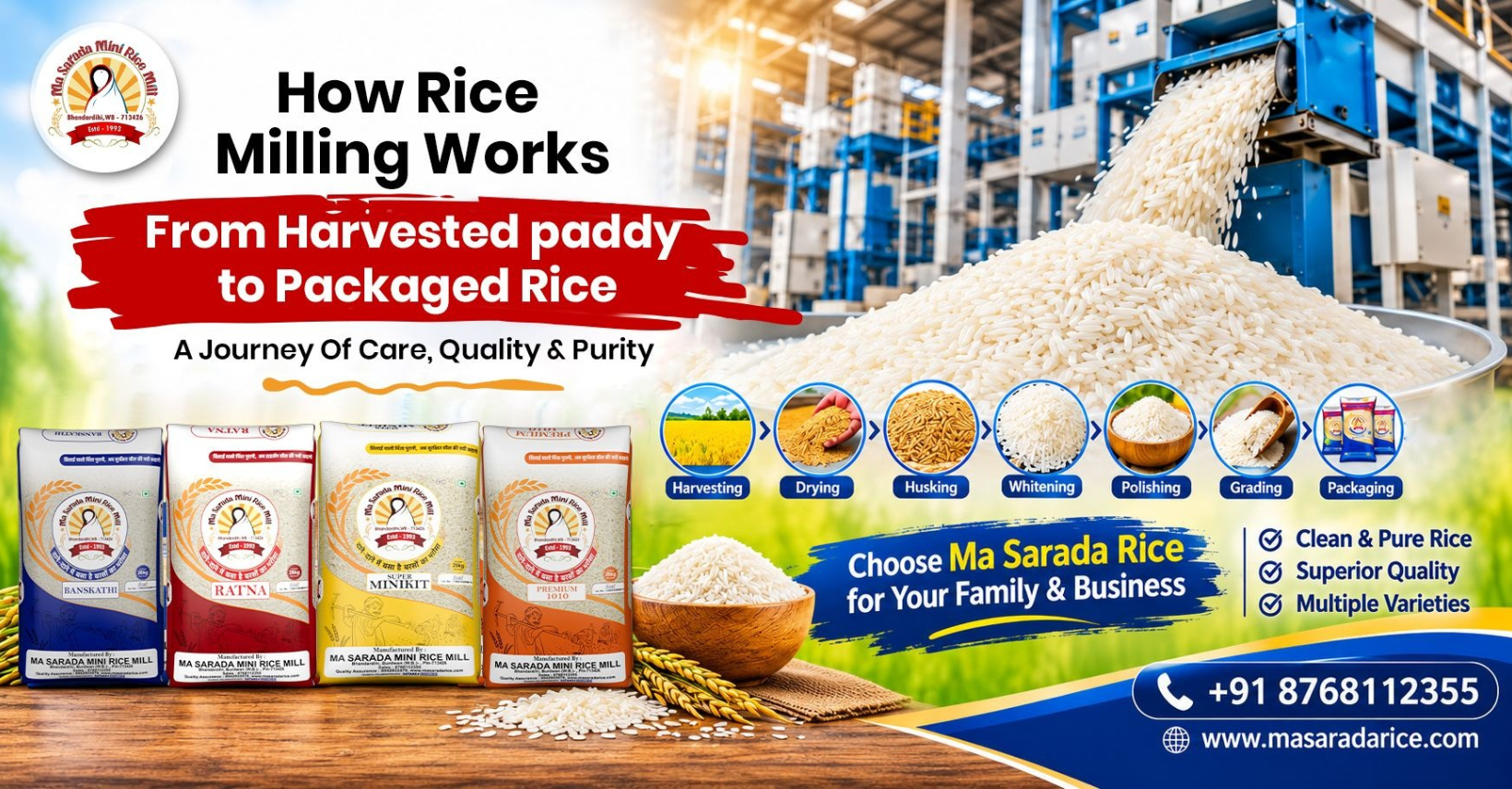
How Rice Milling Works: From Harvested Paddy to Packaged Rice
Rice is an important part of our daily life in India. But before reaching to our house or store, it goes through multiple processing stages. Harvested paddy is gradually transformed into clean and packaged rice.
During rice milling, there are several steps that make rice ready for consumption. These include drying, cleaning, husking, whitening, polishing, grading and packaging.
Knowing how rice is milled can help retailers and wholesale customers identify exactly what is going on when producing your rice and what will affect your rice quality.
What Is the Rice Milling Process?
Rice milling is a process used to remove the outer husks and bran layers from paddy to turn it in to consumable rice.
During harvesting and transport the paddy can become contaminated with foreign matter such as dust, stones and straw. These contaminates are removed using specialist equipment in rice milling.
The aim is to produce clean rice with good separation without damaging the grain.
10 Important Stages of Rice Milling
1. Harvesting
Paddy crop is harvested from the farms. It is then moved to the rice mills. The moisture and quality of the paddy will have an impact during the milling process.
2. Drying
Freshly harvested paddy has too much moisture. It needs to be dried so that it is at the correct moisture levels. The rice mill can dry the paddy using sun drying or dryers.
3. Cleaning
Cleaning machines are used to remove any unwanted debris from the paddy. This includes dust, stones, straw, dry leaves and other farm particles.
4. De-stoning
De-stoning machines separate out heavier objects such as stones to leave the paddy cleaner.
5. Husking
Husking removes the outer protective covering of paddy to produce brown rice. Rice mills commonly use rubber-roll husking machines. The removed husk is separated and collected as a by-product.
6. Paddy Separation
After husking, some grains may still retain their outer covering. A paddy separator separates these unhusked grains from brown rice. Unhusked paddy can be sent back for another husking cycle.
7. Whitening and Bran Removal
Brown rice contains bran layers that are removed during whitening to produce white rice. Specialised machines gradually remove these layers, while the separated rice bran can be collected for other commercial applications.
8. Rice Polishing
Polishing improves the surface finish and appearance of milled rice. The degree of polishing depends on the desired product specifications and rice variety.
9. Grading and Sorting
Rice passes through grading equipment to separate full grains, broken grains and defective or discoloured grains. Modern mills may also use optical colour sorters to improve the visual uniformity of finished rice.
10. Weighing and Packaging
The final rice is weighed and packed into bags according to market requirements. Proper packaging helps protect rice during storage, transportation and distribution to retailers, wholesalers and consumers.
Common Rice By-Products
When processing rice, there are a number of by-products that can be produced.
Rice Husk – This is the protective shell of the rice. It is often used as a biomass fuel source.
Rice Bran – This is the outer layer of the rice which has been removed during the whitening process. It is then used to produce rice bran oil.
Broken Rice – These are pieces of rice that have been separated during grading. Used within food processing.
Rice Straw – This is waste produce from harvesting the paddy.
Why Is It Important To Have Rice Milled Correctly?
Correctly milling rice will help you to create it in a way to suit your customer and commercial needs. Benefits of having rice milled correctly include:
Cleaner – Remove unwanted particles.
Uniform – Grading and sorting will help keep the rice uniform.
Less Broken Grains – Processing rice in a controlled way will help to reduce unnecessary broken grains.
Easier To Handle – Packaging the rice correctly will make it easier to store and transport.
Consistent Product – Processing correctly will help to meet different specifications.
Different Rice Varieties
There are many rice varieties available. They will have different qualities, appearance and cooking properties. Within households, it may be more important to have the rice that you like to cook with. However, within hotels, restaurants, retail and wholesale it may be more important to have uniform rice that will be in demand.
Ma Sarada Mini Rice offers a range of rice varieties to help meet household and commercial needs within Bihar and Jharkhand.
We have Ratna Rice, Super Miniket Rice, Banskathi Rice and Premium 1010 Rice available. You can browse our range below and select what you like.
From Paddy to Packaged Rice
There are many processes to go through when turning paddy into packaged rice. This includes cleaning, drying, husking, whitening, grading and packaging.
We understand how important it is to provide the correct varieties of rice to your household, retail and wholesale customers. We are the original creators of Sarada Rice and supply customers throughout Bihar, Jharkhand and surrounding areas.
Looking for the right varieties of rice for your household or business? Browse our range at Ma Sarada Rice.
FAQs
1. What is the rice milling process?
Rice milling is the process of converting harvested paddy into edible rice through cleaning, drying, husking, whitening, grading and packaging.
2. What are the main stages of rice milling?
The main stages include paddy cleaning, drying, de-stoning, husking, paddy separation, whitening, polishing, grading and packaging.
3. What is the difference between husking and whitening?
Husking removes the outer protective covering of paddy, producing brown rice. Whitening removes the bran layers to produce white rice.
4. Why is drying important before rice milling?
Drying reduces excess moisture in harvested paddy, making it more suitable for storage and further processing.
5. What are the main by-products of rice milling?
The common by-products are rice husk, rice bran and broken rice. These materials have various commercial and industrial applications.
6. How does rice grading improve finished rice?
Grading separates full grains, broken grains and defective grains according to their size and appearance, helping produce more uniform batches.
7. Which rice varieties are available at Ma Sarada Rice?
Ma Sarada Rice offers Ratna Rice, Super Miniket Rice, Banskathi Rice and Premium 1010 Rice for different household and commercial requirements.