
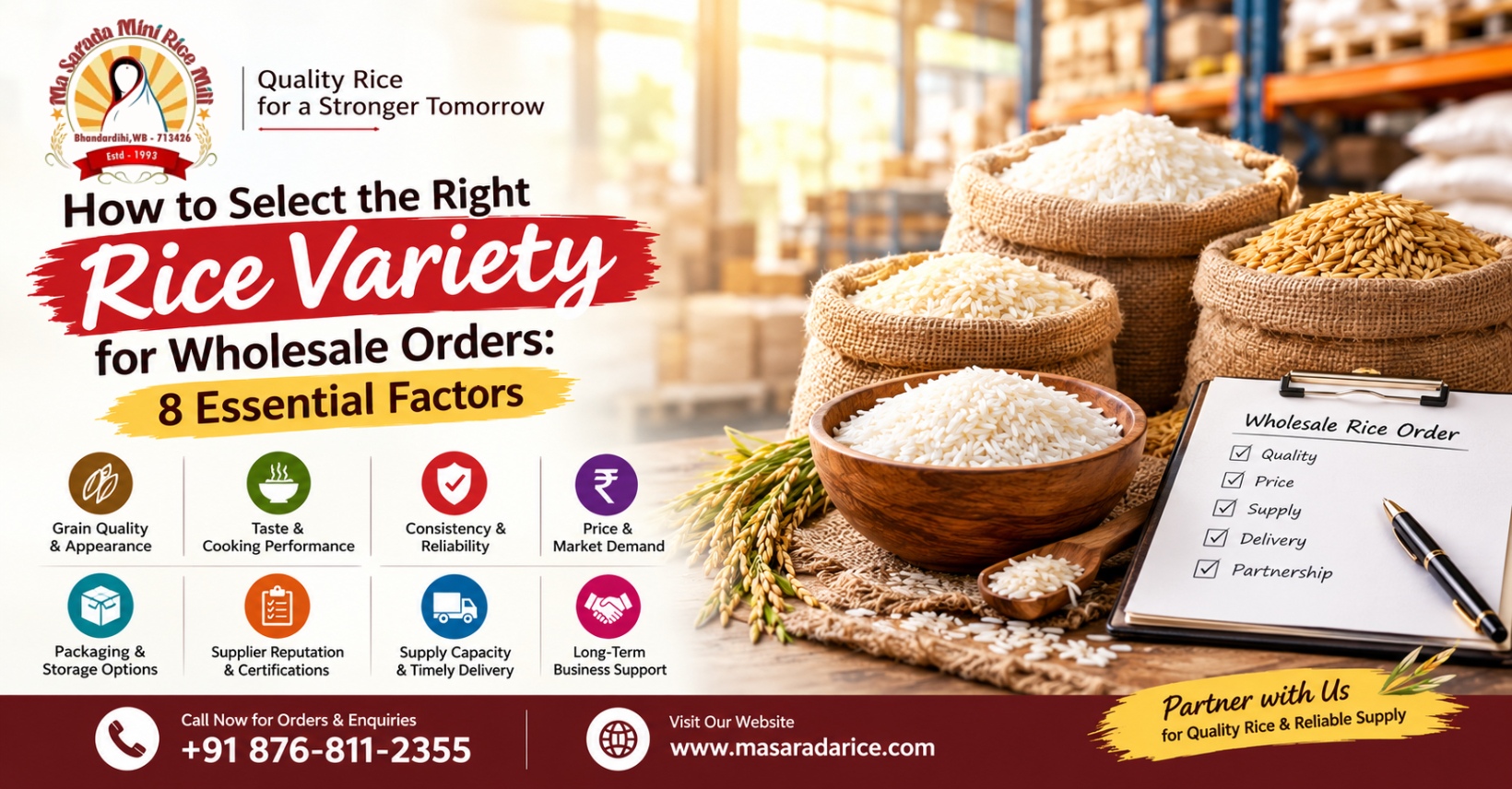
How to Select the Right Rice Variety for Wholesale Orders: 8 Essential Factors
When looking to purchase rice in bulk, it is important to consider what types of rice will be best for your business. There are several factors to consider, including grain quality, customer preference, packaging, storage, transportation, and supplier reliability. Choosing the right type will help ensure that you have consistent products, keep your buying costs down, and ensure that you can consistently meet your customers’ needs.
Understanding these factors can help when searching for a Wholesale Rice Supplier in Bhagalpur. Ma Sarada Rice offers 4 different Rice Types. These include Ratna, Super Miniket, Banskathi, and Premium 1010. You can compare the features and suitability for your customers to decide what to include in your bulk stock.
1. Understand the Quality and Characteristics of Each Rice Variety
Before you get down to ordering rice, it is important to understand the different varieties you will be buying. The quality (including grain type, size, consistency, broken grains, and cooking qualities) can affect how customers rate your product.
Compare the different varieties:
-
Ratna Rice – Is it suitable for regular household cooking?
-
Super Miniket Rice – What does the grain look like? How will it cook? Is it suitable for your customer base?
-
Banskathi Rice – Does it have good grain qualities? Is it suitable for your local buyers?
-
Premium 1010 Rice – Does it have consistent grain, good grain, and good cooking qualities?
Don’t choose a variety based just on the name. Ask for details about the product and, if possible, view a sample.
2. Identify Customer Demand and Your Target Audience
The type of rice you buy in bulk will depend on what your customer requirements are. If you are selling to a retail store that sells to households, you may have different product requirements than if you are supplying a distributor who sells to hotels/restaurants/institutions.
Retail stores:
Focus on the most popular household varieties.
Distributors:
Look at what is popular in different retail stores. Choose a range of different varieties.
Hotels/Restaurants:
Consider how well it cooks, how consistent it is, and if it will work for the dishes they serve.
Bulk buyers:
Consider what packaging is available, how much they need, product specifications, and availability.
If you are working with businesses in Bhagalpur, take into consideration what is popular with your local customers. You can look at past sales, what your retailers say, and how often they reorder to ensure you aren’t over-ordering a slow-moving item.
3. Compare Wholesale Pricing and Bulk Order Requirements
Price is an important consideration. When trying to find the best deal, you may want to look at what the cheapest price actually is as this doesn’t necessarily mean that you’ll get the best deal. You may want to find out how much you’re paying overall for your order including any packaging and delivery costs.
Ask your suppliers for details on:
-
Cost per kg/bag/pack
-
Packaging sizes available and bulk sizes
-
Minimum order quantity (if any)
-
Delivery and handling costs
-
Payment terms and any discounts included
-
How long the price is valid for and any conditions for future orders
This will help you understand the cost differences between each product (Ratna, Super Miniket, Banskathi, Premium 1010) and how much of a cost it would be to have different varieties stocked.
Having a clear breakdown will also help you work out your expected selling price and your wholesale margin.
4. Check Packaging and Storage Requirements
The packaging is an important aspect for protecting the rice. If you’re buying wholesale, check that packaging is well sealed, clean and undamaged.
Ensure the bags are sealed properly, clean and undamaged. The labelling on the bags should include all relevant details such as variety, net weight, details about the manufacturer/packer and any other statements.
When storing rice it should be kept in a clean, dry and well ventilated area. Ensure it isn’t exposed to damp, pests, floor and strong smells.
Retailers/ distributors could implement a stock rotation system to ensure you are not left with old stock for too long. Keep track of your purchase dates and how much you have in stock.
5. Evaluate Supplier Reliability and Communication
A wholesale supplier must provide clarity around product descriptions, ordering requirements, and stock availability. This is particularly important if you will be regularly buying rice from them.
Things to consider;
-
Clear product description.
-
Can they tell you what varieties and quantities they have?
-
Are they quick to respond to queries around ordering?
-
Pricing and payment terms are clear.
-
How do they handle stock shortages, delays, and any concerns around the products?
When looking for a Wholesale Rice Supplier in Bhagalpur, it is important to compare the quality of the products, and how well they communicate with you, and can manage the required order quantities. By getting a clear understanding, you will avoid any confusion when placing orders in the future.
6. Consider Transportation, Logistics and Delivery Arrangements
Delivery can have a great impact on the total cost of your wholesale rice. If you are unsure about how your products will be delivered, it can cause extra costs.
Before placing your order, discuss with your supplier:
-
The distance between your business and the suppliers
-
Delivery costs and who will pay
-
How long the order will take to dispatch and deliver
-
What vehicle they will use and unloading
-
How the rice bags will be protected during delivery
-
What to do if items are damaged or arrive short.
When choosing a supplier in Bhagalpur, it can be helpful to compare how far away they are and what the overall delivery cost will be. You should also make sure they can organise deliveries to fit around your stock needs.
If you need regular stock top-ups, having clear delivery arrangements is very important.
7. Conduct Cooking Trials and Check Rice Quality
This can give you some valuable insight into the product. If you have a large order to place as a wholesaler, cooking a sample of rice could be a good idea.
-
Grain quality – Are the grains fairly uniform and not too dirty?
-
Cook time – How quickly does it cook?
-
Texture – Is it the right texture for your customers?
-
Absorption – How well do they absorb water?
If possible, repeat the test. This will help identify if there is consistency between samples.
Compare Ratna, Super Miniket, Banskathi, and Premium 1010 based on your customer's preferences. Results could vary depending on the batch of rice, how old the rice is, how it has been stored, and how it is going to be cooked. So try not to decide anything based on one observation.
8. Check Food Safety, Quality Control and Milling Standards
Documentation regarding food safety and quality should be in place during the wholesale buying process. Buyers should be aware of the checks that have been done before packing and supplying.
Ask suppliers about their cleaning, grading, sorting, handling and packing processes. If relevant to the product you are purchasing or if it is a requirement for your buying criteria, ask if they have colour sorting equipment. Not all rice mills will follow the same processes.
Buyers should also ensure that FSSAI registration/licence details are correct. Ensure that labelling of the products are correct according to food labelling requirements.
This gives the wholesale buyer confidence and allows them to make an informed choice. Relevant invoices, product information and supplier documentation should be stored.
Choose Rice Varieties That Match Your Wholesale Requirements
Selecting rice for bulk purchasing requires a balanced assessment of product quality, customer demand, pricing, packaging, logistics, and supplier standards. Comparing these factors before placing an order can help retailers, distributors, and commercial buyers make more practical purchasing decisions.
At Ma Sarada Rice, buyers can explore Ratna, Super Miniket, Banskathi and Premium 1010 rice varieties according to their business requirements. Contact our team to discuss available varieties and wholesale purchasing enquiries.
Frequently Asked Questions
1. What factors should be considered when buying bulk rice?
Grain quality, rice variety, cooking properties, price, packaging, storage, delivery, and supplier reliability.
2. What rice varieties can be compared?
Ratna, Super Miniket, Banskathi, and Premium 1010 can be compared depending on your customers’ preferences, properties, cooking, and purchasing requirements.
3. Why should you cook a sample?
This will help you understand how long the rice takes to cook, how the texture is, how much water it absorbs, and how consistent it is. It will also show if the variety fits with your customers’ expectations.
4. How can you compare prices for bulk rice?
Look at the price per kg/bag, quantity, packaging fees, delivery costs, and payment terms. Taking a look at the overall cost to purchase will help you compare the price.
5. What should you look out for in relation to packaging?
Check that the bags are in good condition, sealed well, clean, labelled with the product, correct net quantity, and labelled correctly. If they aren’t well packaged or have been stored incorrectly, this may affect the product.
6. Why is delivery important when purchasing bulk rice?
Delivery can affect how quickly the rice gets delivered, how much it costs to handle and how the rice bags are. Make sure you know how much delivery costs, unloading, and what happens if the product is damaged/under delivered.
7. How can I find a good supplier for bulk rice in Bhagalpur?
Look at the variety of rice they offer, samples, clear pricing, correct food safety documents, packaging, delivery, and communication. Talk to them about how much you need before ordering in bulk.