
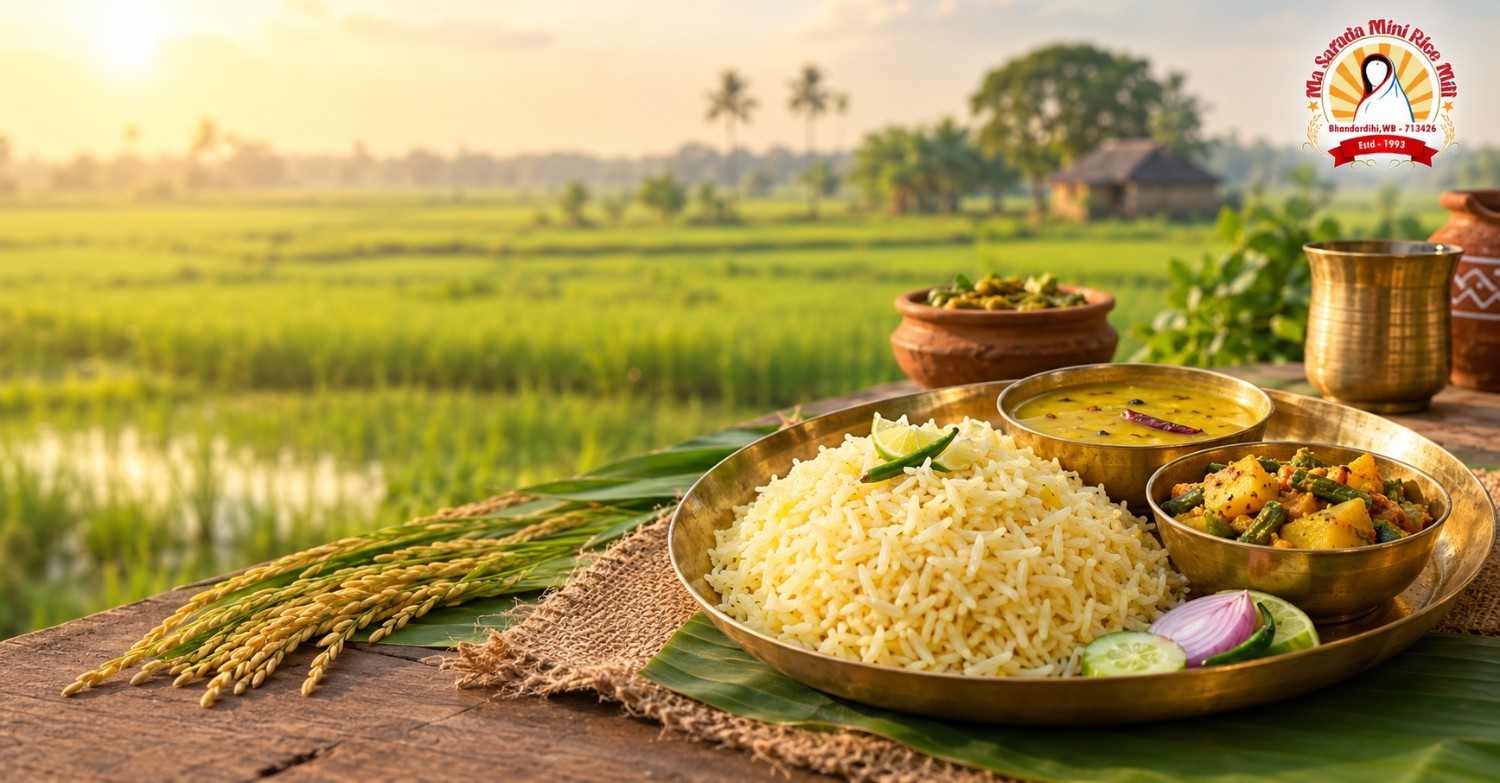
Why Is Parboiled Rice Popular in Bihar, Bengal and Jharkhand?
Walk into any home kitchen in Patna, Kolkata or Ranchi at lunchtime and you’ll find a pot of rice on the stove. Look closely at the grains and, in most homes, they are slightly golden, firm and separate. That is parboiled rice, known as usna chawal in Bihar and Jharkhand and siddho chal in Bengal.
At Ma Sarada Rice, we hear one question from families, shopkeepers and wholesale buyers across the region: why does this region prefer parboiled rice over raw rice? The answer is a mix of climate, farming history, kitchen habits and plain practicality. Let’s go through it.
What Is Parboiled Rice?
Parboiled rice is rice that is partially boiled while still in its husk. The process has three steps:
- Soaking: Paddy (unhusked rice) is soaked in warm water.
- Steaming: The soaked paddy is steamed under pressure, which gelatinizes the starch inside the grain.
- Drying and milling: The paddy is dried, then milled to remove the husk and bran.
This changes the grain. It becomes harder, slightly amber before cooking, and turns off-white once cooked. It also stays firm and non-sticky, which is the quality people in this region value most.
Why Parboiled Rice Is Popular in Bihar, Bengal and Jharkhand
1. Climate and Traditional Storage
Eastern India is hot and humid for much of the year, and monsoon moisture is a constant challenge for grain storage. Because parboiling hardens the grain, it resists breakage and is generally less prone to damage during handling and storage. Households that buy rice in 25 kg or 50 kg bags value this, as do small retailers and wholesalers.
2. A Farming and Milling Tradition
Paddy is grown widely across the Gangetic plains and the plateau regions of Jharkhand. Over generations, local mills adapted to parboiling, partly because parboiled paddy mills with fewer broken grains. That tradition built a supply chain and, with it, a taste. Many people here grew up eating it and simply never switched.
3. It Suits the Way We Eat
Daily meals in this region are built around dal-bhat, machher jhol, sabzi and bhaat with aloo bhaja. These need rice that is soft but separate, so it holds up under ladles of dal and gravy without turning mushy. Parboiled rice does this well. It also works for panta bhat (fermented rice) in Bengal, and for khichdi and rice served at festivals and community meals.
4. It Stays Filling
Parboiled rice tends to digest a little more slowly than polished raw rice, so many people find it keeps them full longer. This matters for farmers, labourers and anyone with a long workday ahead. Food scientists also note that parboiling helps retain more of the grain’s natural B-vitamins than milling raw rice, because some nutrients move inward from the bran during steaming. It is not a medical food, and anyone managing diabetes should still watch portion sizes and ask their doctor or dietitian.
5. Value for Money in Bulk
For large families, hostels, caterers and wedding kitchens, parboiled rice cooks consistently and is forgiving. Overcooking by a few minutes rarely ruins a pot, which is a big advantage when you are cooking for 100 people.
Parboiled Rice vs Raw Rice: What’s the Difference?
People often search for parboiled rice vs raw rice or raw vs parboiled rice when deciding what to buy. Here is a simple comparison.
| Feature | Parboiled Rice | Raw Rice (Normal/Steamed-Free) |
|---|---|---|
| Processing | Partially cooked in husk before milling | Milled directly after drying |
| Colour before cooking | Light golden/amber | White or off-white |
| Cooked texture | Firm, separate grains | Softer, can be sticky |
| Cooking time | Slightly longer | Slightly shorter |
| Breakage | Lower | Higher |
| Best for | Daily meals, biryani, bulk cooking | Idli/dosa batter, lighter dishes, some sweets |
| Smell | Mild, slightly earthy | Neutral |
If you’re wondering about parboiled rice and raw rice difference in taste, parboiled rice has a mild, slightly nutty character, while raw rice tastes cleaner and softer. Neither is “better.” It depends on what you’re cooking. The difference between parboiled rice vs normal rice is mostly about texture and how it behaves in the pot.
One point of confusion: parboiled rice is not the same as “converted” rice from a marketing label, and it is not undercooked. It is fully safe, and it finishes cooking in your kitchen like any other rice.
Choosing the Right Parboiled Rice: What to Check
Not all parboiled rice is the same. When buying, look for:
- Uniform grain length with minimal broken pieces
- Even colour, with no dark or black spots
- A clean, mild smell, since an off or musty smell can mean poor storage
- Clear packaging details such as variety, packing date and weight
- Consistent cooking results across bags, which only comes from controlled milling
Rice varieties matter too. Ratna Rice is a widely cooked everyday variety in the region, valued for its dependable texture. If you want a cleaner, more polished grain for guests and special meals, a Banskathi Rice grade with longer, more uniform grains is usually the better pick. Many wholesale buyers in the trade also look for Premium 1010 rice, which is known for its long, slender grain and is popular in biryani and restaurant kitchens.
Ma Sarada Rice in Bihar, Jharkhand and West Bengal
Customers often tell us they want a rice that tastes the way they remember from home. That is the standard we aim for.
Ma Sarada Rice in Bihar serves households, retailers and wholesalers who want dependable parboiled rice for daily cooking and bulk orders. In Jharkhand, Ma Sarada Rice is chosen by families and shops that want firm, clean grains at fair prices. And Ma Sarada Rice in West Bengal is a natural fit for Bengali kitchens, where bhaat is the centre of every meal.
Where you can find us: We supply households, retailers and wholesalers across West Bengal, Bihar and Jharkhand. This includes towns such as Munger and Bhagalpur in Bihar and Deoghar in Jharkhand.
Talk to us directly:
- Phone: 08768112355
- Email: masaradarice@gmail.com
- Contact page
How to Cook Parboiled Rice Perfectly
A few habits make a big difference:
- Rinse 2 to 3 times until the water runs mostly clear.
- Use roughly 2 to 2.5 parts water to 1 part rice, depending on the variety and age of the rice. Older rice needs a little more.
- Bring to a boil, then simmer covered on low heat for about 15 to 20 minutes.
- Rest for 5 minutes off the heat, then fluff with a fork.
If you prefer the traditional method, cook it uncovered in plenty of water and drain the excess, as many Bengali and Bihari homes do.
Frequently Asked Questions
1. What is parboiled rice?
Parboiled rice is rice that has been soaked, steamed and dried in its husk before milling. The process hardens the grain and gives it a firm, non-sticky texture when cooked.
2. Why is parboiled rice so popular in Bihar, Bengal and Jharkhand?
It suits the local climate and storage conditions, matches regional dishes like dal-bhat and fish curry, and has been part of the region’s milling tradition for generations. It is also filling and forgiving to cook in bulk.
3. What is the difference between parboiled rice and raw rice?
Parboiled rice is partially cooked in the husk before milling, so it is firmer, more golden and less likely to break. Raw rice is milled directly, so it is whiter and cooks softer.
4. Is parboiled rice healthier than raw rice?
Parboiling helps retain some of the grain’s natural nutrients, and many people find parboiled rice more filling. However, it is still rice, so portion size matters. People with diabetes or other conditions should follow their doctor’s advice.
5. Is parboiled rice the same as undercooked rice?
No. It is only partially cooked at the processing stage, and it is fully safe. You still cook it completely at home.
6. Which is better for daily meals, parboiled rice or normal rice?
For everyday dal, sabzi and fish dishes, most families in eastern India prefer parboiled rice for its texture. Raw rice works better for dishes like idli and certain desserts. So the better choice depends on what you cook.
7. Can I use parboiled rice for biryani and pulao?
Yes. Its firm grains hold up well to long cooking and layering. For biryani, many cooks prefer a long-grain variety such as 1010 rice.
8. What is Ratna Rice, and is it parboiled?
Ratna is a popular rice variety in the region. It is commonly available in parboiled form, and it is valued for consistent texture and everyday affordability. Check the packaging to confirm the processing type.
9. How should I store parboiled rice?
Keep it in a cool, dry place in an airtight container, away from moisture and direct sunlight. In humid months, check periodically and avoid mixing old and new stock.
10. Where can I buy Ma Sarada Rice?
Ma Sarada Rice is available through retailers and distributors in Bihar, Jharkhand and West Bengal. For bulk or wholesale enquiries, contact the Ma Sarada Rice team directly. (Add your phone number, email or enquiry page link here.)
Final Thoughts
Parboiled rice isn’t popular in Bihar, Bengal and Jharkhand by accident. It grew from the region’s climate, farming and cooking habits, and it keeps earning its place with firm grains, dependable results and good value. Whether you’re comparing parboiled vs raw rice for your kitchen or sourcing stock for your shop, the best choice is a rice you can trust, bag after bag.